
Talisman
The Magical Quest Game
Bob Harris, the creator of Talisman, gives some background on the history of the game.
Since it was first published in 1983 Talisman has gained a world-wide following. Editions have been published under license as far afield as Israel, and Australia. I thought that I would give my own story of how it came to be.
Genesis
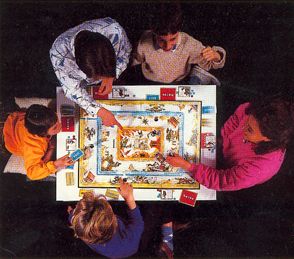 Our
tale begins in the early 1980s in Deans Court, a small residence of
postgraduate students at St. Andrews University. It was my future wife
Debby who suggested that a group of us put our money together and buy
something called 'Dungeons And Dragons' from the local toy store. She
had played the game back home in Florida and assured us that it was
great fun. "So you pretend you're wandering around in a tunnel and you
draw a map of it?" I remember saying skeptically. But still, I parted
with my share of the cost.
Our
tale begins in the early 1980s in Deans Court, a small residence of
postgraduate students at St. Andrews University. It was my future wife
Debby who suggested that a group of us put our money together and buy
something called 'Dungeons And Dragons' from the local toy store. She
had played the game back home in Florida and assured us that it was
great fun. "So you pretend you're wandering around in a tunnel and you
draw a map of it?" I remember saying skeptically. But still, I parted
with my share of the cost.
Our first session was run by Tony Cant, a physicist who had played the part of Games Master back in his native Australia (among his other accomplishments were the fact that he spoke six languages and had the largest collection of punk rock LPs I had ever seen).
We played for an entire weekend, hardly pausing for sleep or food. It was an intoxicating experience as character after character was horribly killed to be replaced by another freshly created adventurer. After that we played regularly, but while others worked up new scenarios, I had it in mind to come up with a way we could have all the excitement of a roleplaying adventure without all the hard work of creating characters and drawing maps. At the back of my mind was a game I had designed while still a pupil at Morgan Academy in Dundee. It was called 'Rectocracy' and involved each player taking on the character of one of the teachers. You moved around the board, gradually working your way towards the centre, where you would try to make yourself Rector (headmaster/principal) of the school. I had a notion that I could use a similar layout to make a fantasy adventure game.
It Lives! It Lives!
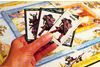 As the characters in the game
were meant to be as interesting as those in a roleplaying game, I gave
each of them two or three special abilities and assigned them a moral
rating of Good, Evil or Neutral. In addition to this they each had a
Strength rating to represent their physical prowess, and a Craft rating
to represent their mental and spiritual faculties. Spaces on the board
represented a landscape where various encounters would take place by
means of drawing cards. As the character moved around the board he
would acquire gold, objects, followers and magic spells. He would also
be able to increase his Strength and Craft.
As the characters in the game
were meant to be as interesting as those in a roleplaying game, I gave
each of them two or three special abilities and assigned them a moral
rating of Good, Evil or Neutral. In addition to this they each had a
Strength rating to represent their physical prowess, and a Craft rating
to represent their mental and spiritual faculties. Spaces on the board
represented a landscape where various encounters would take place by
means of drawing cards. As the character moved around the board he
would acquire gold, objects, followers and magic spells. He would also
be able to increase his Strength and Craft.
As he grew more powerful the character would be able to make his way towards the centre of the board through increasingly dangerous regions until he finally reached the centre with the aid of a mystic talisman. At this point I was calling the game 'Necromancer' and at the centre of the board was the Necromancer's Isle, where a player would gain the means of killing off all of his rivals.
The first version was drawn up entirely in pencil so that I could make changes. In spite of this rather lame appearance, the first game went tremendously well and all my fellow game enthusiasts were eager to play again.
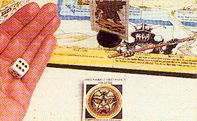 Two
particularly fun things became clear. Whenever someone was making a die
roll that might turn them into a toad, all the other players would
spontaneously start chanting, "Toad! Toad! Toad!" The other interesting
factor was that the person who was first to reach the centre of the
board rarely won the game. Usually someone would catch up with him and
clobber him before he could kill off all of the opposition.
Two
particularly fun things became clear. Whenever someone was making a die
roll that might turn them into a toad, all the other players would
spontaneously start chanting, "Toad! Toad! Toad!" The other interesting
factor was that the person who was first to reach the centre of the
board rarely won the game. Usually someone would catch up with him and
clobber him before he could kill off all of the opposition.
The game was so popular among my group of friends that it was no problem play-testing it extensively. I had designed it originally just for our own enjoyment, but if it was this good, might someone be interested in publishing it?
Someone is interested in publishing it
I leafed through various games magazines, looking for a potential publisher. I found an advert by a company called Games Workshop, who at that time were selling four or five hobby games. A couple of years before they had been operating out of the back of a van, selling backgammon sets. I contacted them to confirm they would be interested in seeing a new game. I had by this time fashioned a beautiful full colour set using only my own limited artistic abilities, but the point was simply to give an idea of how good this game could look. I posted this prototype off to Games Workshop and had a reply only a couple of weks later. Next thing I knew I was down in London chatting with Ian Livingston and Steve Jackson and preparing to sign a contract that would give me a royalty for each copy sold. They wanted to make some minor changes, including changing the name to 'Talisman'.
I mentioned casually that I had designed the game in such a way that expansion sets could be added to it if there should be a demand for such things. Everybody laughed good-naturedly.
Lift -off!
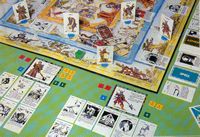 Games
Day 1983. Production of the finished Talisman game had been
running behind schedule so that all I had seen of it up until now were
some black and white xeroxes of the artwork. I had been assured,
however, that there would be lots of copies ready for the launch on
Games Day.
Games
Day 1983. Production of the finished Talisman game had been
running behind schedule so that all I had seen of it up until now were
some black and white xeroxes of the artwork. I had been assured,
however, that there would be lots of copies ready for the launch on
Games Day.
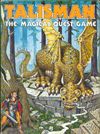
On the day I was somewhat the worse for wear after spending the evening before in a popular Islington pub with some friends. This did little to dim my excitement, however, when Ian Livingston handed me the first brand new boxed set of Talisman. Most of the cards in this first edition were in black and white, but it was still a thing of beauty.
 I
had a pretty busy time of it running demonstration games for hordes of
eager fantatics, but I still found time to chat with Ken St. Andre,
creator of the 'Tunnels and Trolls' RPG which was the basis of the
system I used for running role-playing adventures.
I
had a pretty busy time of it running demonstration games for hordes of
eager fantatics, but I still found time to chat with Ken St. Andre,
creator of the 'Tunnels and Trolls' RPG which was the basis of the
system I used for running role-playing adventures.
On this same day Games Workshop launched another game, one based on insurance whose major (perhaps only) selling point was that it was designed by millionaire composer Andrew Lloyd Webber. I can't remember what it was called, and I don't suppose you can either.
World Conquest
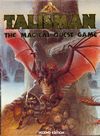 In spite
of the fact that it received a surprisingly mediocre review in GW's
magazine 'White Dwarf' (in those days the reviewers were independent),
the gaming community embraced Talisman with wild enthusiasm. Soon plans
were afoot to produce a glossier, full colour second edition. And
somebody called me to say, "Hey, how about an expansion set?"
In spite
of the fact that it received a surprisingly mediocre review in GW's
magazine 'White Dwarf' (in those days the reviewers were independent),
the gaming community embraced Talisman with wild enthusiasm. Soon plans
were afoot to produce a glossier, full colour second edition. And
somebody called me to say, "Hey, how about an expansion set?"
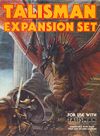 I delivered an expansion set full of new
characters and cards. Citadel miniatures produced a set of Talisman
figures and there was even a short lived computer version. Workshop
produced another in-house expansion set called 'The Talisman
Adventure', which was unfortunately filled with errors that could
easily have been avoided if they had allowed me the opportunity to edit
it. But that's business.
I delivered an expansion set full of new
characters and cards. Citadel miniatures produced a set of Talisman
figures and there was even a short lived computer version. Workshop
produced another in-house expansion set called 'The Talisman
Adventure', which was unfortunately filled with errors that could
easily have been avoided if they had allowed me the opportunity to edit
it. But that's business.
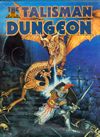 I
delivered another expansion set, 'The Talisman Dungeon', which added a
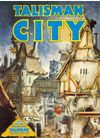
secondary board to the game. Soon two more boards were to be added. A
Canadian fan had designed a set that was released as 'The Talisman
Timescape'. Finally Workshop produced 'The Talisman City.' By now the
game had been licensed to companies in France and Germany. The German
edition advertised it as a "struggle against death and the devil."
I
delivered another expansion set, 'The Talisman Dungeon', which added a
secondary board to the game. Soon two more boards were to be added. A
Canadian fan had designed a set that was released as 'The Talisman
Timescape'. Finally Workshop produced 'The Talisman City.' By now the
game had been licensed to companies in France and Germany. The German
edition advertised it as a "struggle against death and the devil."
 Blimey,
it's only a game!
Blimey,
it's only a game!
Then
it spread to Scandanavia, eastern Europe and Australia. Games Workshop
had opened a US branch and the game became a massive seller there. By
now Talisman was getting rave reviews and one magazine even listed it
as one of the top ten 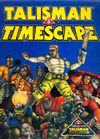 games of all time. It was a regular winner of
the 'Best Fantasy Board Game' award at the annual Games Day.
games of all time. It was a regular winner of
the 'Best Fantasy Board Game' award at the annual Games Day.
I attended one more Games Day where I ran a Talisman tournament and was delighted to hear players chanting, "Toad! Toad! Toad!" as some hapless soul rolled the die.
The end of an era
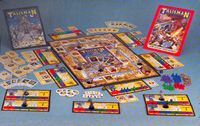 A lot of games now had huge
plastic pieces as their selling point rather than lots of beautifully
illustrated cards. We had discussions about expanding Talisman into a
series of separate games each with lots of plastic bits, but nothing
came of this. In the end a large, glossy third edition was published.
By the time this version had run its course, the chaps at Games
Workshop were a completely different bunch from those I had dealt with
at the beginning. We exchanged letters and phone calls regarding the
future of the Talisman. In the end they offered me a generous sum of
money to buy out my interest in the game. In the life of every creative
individual there comes a time to take the money and run, so I did.
A lot of games now had huge
plastic pieces as their selling point rather than lots of beautifully
illustrated cards. We had discussions about expanding Talisman into a
series of separate games each with lots of plastic bits, but nothing
came of this. In the end a large, glossy third edition was published.
By the time this version had run its course, the chaps at Games
Workshop were a completely different bunch from those I had dealt with
at the beginning. We exchanged letters and phone calls regarding the
future of the Talisman. In the end they offered me a generous sum of
money to buy out my interest in the game. In the life of every creative
individual there comes a time to take the money and run, so I did.
I was very pleased to hear that a new edition of Talisman hit the shops in autumn 2007, a testament to its continuing status as one of the classic board games of all time.
Visit Talisman Island: A good source of more information about Talisman, and the various Talisman expansion products (both commercial and amateur). Lots of links to other Talisman enthusiast sites.